Your Difference Is Not a Deficit: Ann Samuel on Finding Your Place in Tech and Making Room for Others
02 Nov, 20268 MinutesFrom an unexpected start in computer science to leading global technical teams and championi...
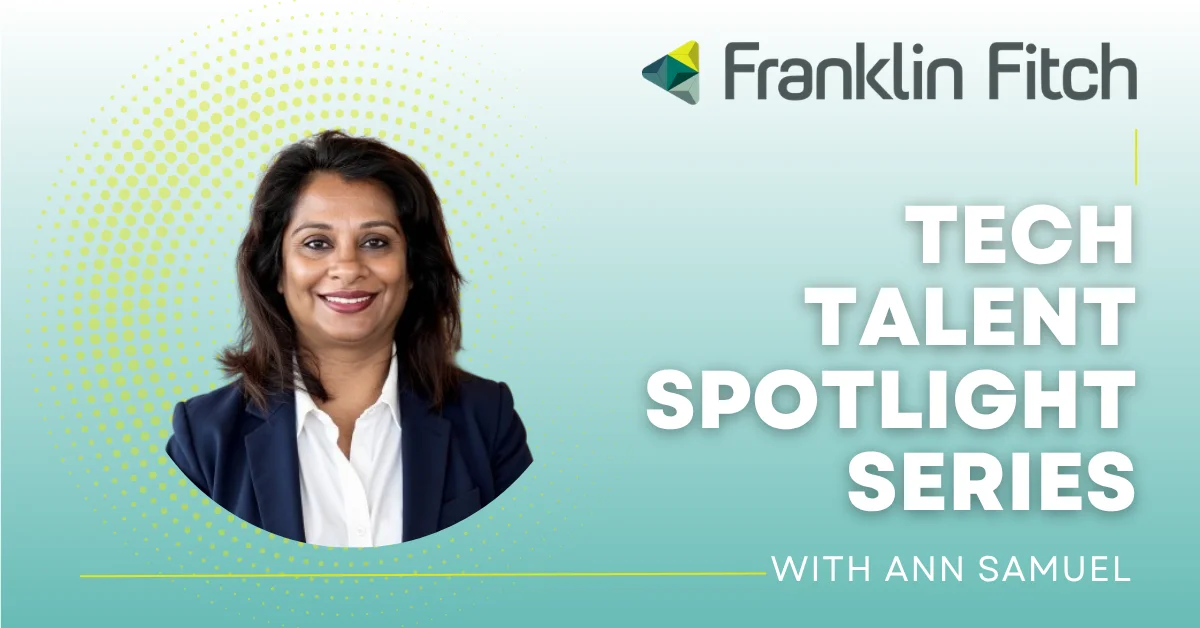
From an unexpected start in computer science to leading global technical teams and championing women in technology, Ann Samuel's career is a story of finding purpose, building communities and challenging what leadership in tech should look like.
What does it take to build a successful career in technology? Technical expertise? Determination? The ability to adapt?
For Ann Samuel, Senior Director of Technical Global Customer Support at Contrast Security, the answer involves all three. But after more than two decades in the industry, she has come to believe that something else is equally important: creating environments where people from different backgrounds feel empowered to contribute, grow and succeed.
Her journey hasn't been entirely straightforward. In fact, a career in technology wasn't even part of the original plan.
As part of our Tech Talent Spotlight series, we spoke to Ann about the unexpected decisions that shaped her career, the barriers she encountered as a woman in technology and why she believes inclusion matters more than ever in an industry being transformed by AI.
Her story is a reminder that there is no single route into technology, no one definition of a successful tech professional and certainly no one type of person who belongs in the industry.
An unexpected route into technology
Ann originally wanted to become a doctor. There was just one problem: she fainted at the sight of blood.
That rather inconvenient discovery prompted a change of direction at a time when computer science was beginning to emerge as an exciting career path.
She decided to pursue the subject, completing both undergraduate and postgraduate degrees in computer science. What began as an alternative to medicine quickly developed into a genuine passion.
She loved the logical thinking involved, the process of breaking down complex problems and working towards solutions.
Her career began in software development before moving into quality assurance and eventually technical customer support. It was in that customer-facing environment that she discovered what she enjoyed most: connecting the people building technology with those using it.
Being able to translate a customer's challenges into something engineers could act on, and explain complex technical solutions in a way customers could understand, gave her a different perspective on the value she could bring.
It also demonstrated something that often gets overlooked when we talk about careers in tech.
Technical skills can open the door, but communication, empathy and problem-solving can take a career in directions you never anticipated.
For Ann, that direction eventually led to leadership.
Discovering the power of different perspectives
One of the defining moments in Ann's career came during her time at Oracle, where she was given the opportunity to build and lead a global team.
The team brought together professionals across Asia-Pacific, Europe, the Middle East and Africa, and the United States. Its members ranged from a 21-year-old graduate taking their first steps in the industry to experienced professionals in their 50s.
Different generations, cultures, career experiences and perspectives were working towards the same goals.
Rather than seeing those differences as something to manage, Ann discovered how powerful they could be.
The experience fundamentally shaped her approach to leadership. She realised that high-performing teams aren't necessarily built by bringing together people who think alike. They're built by creating an environment where different perspectives are welcomed and everyone feels able to contribute.
That lesson has stayed with her throughout her career.
Whether leading engineers, supporting customers or navigating the introduction of AI into technical teams, Ann continues to approach leadership with one central question:
"What does this person need in order to do their best work?"
It's a simple question, but one that challenges leaders to look beyond performance metrics and consider the individual behind them.
When the lack of representation becomes impossible to ignore
While Ann was progressing professionally, she was becoming increasingly aware of something troubling.
There weren't many women around her in engineering.
Working in a satellite office made the lack of representation particularly noticeable. Although employee resource groups existed within the wider organisation, many of their activities were centred around headquarters, making them difficult to access.
There were few women nearby she could turn to for guidance, mentorship or shared experiences.
Then the issue became personal.
When Ann's daughter was considering her future career, technology wasn't on her radar. Nor was it a particularly popular choice among her friends.
Ann found this surprising. During her own computer science studies, she remembers women making up almost 60% of her cohort. Yet as careers progressed, she had watched many women leave the industry, often as family responsibilities and societal expectations made it increasingly difficult to continue.
When her daughter eventually enrolled in computer science, the contrast was striking.
Out of a class of 60 students, just three were girls.
For Ann, this highlighted two connected challenges: encouraging more girls to consider technology in the first place and ensuring women already working in the industry have the support they need to stay and progress.
It also prompted her to take action.
She began teaching children as young as five to code using Scratch, introducing them to technology before they reached the point of making decisions about their future careers.
Her thinking was straightforward: how can young people aspire to careers they don't understand or haven't had the opportunity to explore?
Exposure matters. So does seeing people you can relate to succeeding in those careers.
And sometimes, creating change starts with something as simple as helping a child discover that coding can be fun.
From feeling isolated to building a community of 300
Ann's commitment to supporting women in technology continued to grow.
She began attending networking events and connecting with other women who shared similar experiences. One particularly transformative moment came when she received a Google-sponsored scholarship to attend the Grace Hopper Celebration in 2017.
Walking into an event surrounded by approximately 16,000 women in technology was an experience she describes as life-changing.
After spending so much of her career feeling the absence of women around her, she suddenly found herself surrounded by thousands of people with familiar stories, challenges and ambitions.
It reinforced something she had been discovering through her own experiences: community can be a powerful catalyst for change.
Returning to Oracle, Ann helped establish a grassroots employee resource group for women within Oracle Cloud Infrastructure.
What began with around 50 people eventually grew into a global community of approximately 300.
But her efforts didn't stop when she left Oracle.
Together with former colleagues, she co-founded WIT Align, a non-profit community supporting and mentoring women interested in technology, including those without traditional STEM backgrounds who are considering entering the industry.
She also launched SisterCode, a podcast with her sister, who works as a Director of Engineering at Red Hat.
The podcast grew from the conversations they were already having about navigating careers, dealing with setbacks, reinventing yourself professionally and finding your place in an ever-changing industry.
By sharing those discussions more widely, they hope to make the guidance, reassurance and shared experiences that helped them accessible to others.
There's an important lesson here for the wider technology industry.
Inclusion doesn't always begin with a large corporate initiative or a formal programme. Sometimes it begins with someone recognising a gap and deciding to do something about it.
Getting a seat at the table is only half the challenge
Of course, building a successful career as a woman in technology hasn't been without its difficulties.
Ann describes how her upbringing and cultural background shaped her naturally soft-spoken communication style.
Early in her career, she realised that being knowledgeable and having valuable ideas didn't always guarantee being heard.
She recalls situations where her contributions were overlooked, only for the same ideas to receive recognition when repeated by someone else.
It is an experience many women in male-dominated industries will recognise.
Over time, Ann learned to adapt how she communicated, becoming more comfortable speaking up and making her presence felt without compromising her personality or values.
But she is clear that the responsibility for inclusion cannot rest solely with those who have historically been excluded.
Workplaces must also become better at recognising different communication styles, challenging unconscious assumptions and ensuring everyone has an opportunity to contribute.
For Ann, one of the biggest frustrations is seeing women overcome significant barriers to reach senior positions without then extending the same opportunities to others.
As she puts it:
"Once you get there, you build your own, but you've got to pull up some chairs as well."
One experience at Oracle brought the importance of this into particularly sharp focus.
During an all-hands meeting attended by approximately 400 people, a senior leader asked women in technical and leadership positions to stand.
As the seniority requirements increased, more and more women sat down.
By the time the exercise reached Senior Director and VP level, only a handful remained standing.
The silence in the room spoke volumes.
For Ann, it was a visual representation of something that statistics alone often struggle to communicate: representation at entry level means little if opportunities to progress remain unequal.
It also reinforced her determination to make inclusion an active part of how she leads.
Not simply asking who is in the room, but who is missing, why they aren't there and what can be done to change that.
Why diversity matters even more in the age of AI
Technology has changed dramatically throughout Ann's career, but perhaps no development has created as much uncertainty as the current acceleration of artificial intelligence.
Layoffs, automation and questions about the future of technical roles have shifted the conversation across the industry.
For employees, the focus is increasingly moving from career development and belonging towards a more immediate concern: job security.
Ann believes this presents a significant challenge for leaders.
Building trust and psychological safety becomes more difficult when employees are uncertain about their futures. Yet these are precisely the conditions people need to experiment, learn new skills and adapt to technological change.
Her view is that leaders need to approach AI transformation with transparency, accountability and a genuine commitment to helping their teams develop.
Rather than simply introducing new technology and expecting people to adapt, organisations need to help employees understand where they fit into the future.
And while AI may change the skills required in many technical roles, Ann doesn't believe it eliminates the importance of human expertise.
Judgement, empathy, contextual understanding and the ability to navigate complex, ambiguous situations remain essential.
But her argument for diversity goes further than protecting opportunities for people working in technology.
It is also about the technology we create.
Ann recalls attending a keynote by AI pioneer Dr Fei-Fei Li at the Grace Hopper Celebration in 2017, where a question stayed with her:
"AI will change the world, but who will change AI?"
Almost a decade later, that question feels particularly relevant.
AI systems are shaped by the data, decisions and assumptions of the people who develop them.
If those people represent only a narrow range of backgrounds and experiences, the technology they create risks reflecting and amplifying their blind spots.
As AI becomes increasingly embedded in products and services used by people around the world, diverse perspectives are not simply desirable. They are essential to building technology that works for the people it is intended to serve.
For businesses, that means moving beyond diversity as a hiring target.
It means creating environments where people with different experiences can meaningfully influence decisions, challenge assumptions and contribute to the development of technology.
Representation gets different perspectives into the room. Inclusion ensures those perspectives actually shape what happens next.
The future of tech needs different voices
Despite the uncertainty surrounding the technology industry, Ann remains optimistic about the opportunities ahead.
Her message to young women considering a career in technology is not to be discouraged by the headlines.
After more than 20 years in the industry, she has seen technologies evolve, roles change and new opportunities emerge.
As she puts it:
"Tech doesn't die, it shifts."
And with that shift comes an opportunity to rethink what makes someone successful in technology.
As AI takes on more repetitive technical tasks, the ability to understand problems, ask meaningful questions, exercise judgement and learn quickly becomes increasingly valuable.
These aren't qualities reserved for people with a particular degree, background or personality.
They're skills that can be developed, strengthened and applied across a wide range of technology careers.
Ann's advice to those entering the industry centres on three ideas.
Your difference is not a deficit. Your background, culture and experiences give you a perspective that others may not have. Don't feel pressured to erase what makes you different to fit an existing mould.
Find your people early. Build relationships with mentors, peers and communities who will support you, challenge you and help you grow. You don't have to navigate your career alone.
Be ambitious out loud. Know what you want, communicate your goals and don't apologise for having aspirations.
These lessons extend far beyond women entering technology. They apply to anyone who has questioned whether they belong in an industry, whether their background is the right one or whether they need to change who they are to succeed.
Building an industry where everyone has a place
Ann's story is about much more than an individual career journey.
It's about the opportunities that emerge when people are encouraged to explore unfamiliar paths. The difference that mentorship and community can make. And the responsibility that comes with reaching a position where you can influence opportunities for others.
It also raises an important question for technology employers.
If we want to attract and retain people with different backgrounds, experiences and perspectives, are we creating workplaces where they can genuinely thrive?
That requires more than widening recruitment pipelines. It means examining how people are supported, how their contributions are recognised, who receives opportunities to progress and whether leaders are actively building environments where different voices can be heard.
At Franklin Fitch, our Tech Talent Spotlight series aims to bring these conversations to the forefront by sharing the experiences of people who have built careers in technology through different routes.
Because making technology more inclusive starts with challenging assumptions about who belongs in the industry and recognising that talent doesn't come in just one form.
Perhaps the most important message from Ann's journey is also the simplest:
"Your difference is not a deficit."
The future of technology needs people who think differently, bring new perspectives and challenge established ways of doing things.
The industry's responsibility is to make sure they have the opportunity to do so.