How AI Is Reshaping Talent, Culture, and the Future of Work - Tech Talent Spotlight with Alice Yoo Leclair
06 Oct, 20268 MinutesIf you’re trying to understand how AI is changing the way we work - not just the tools...
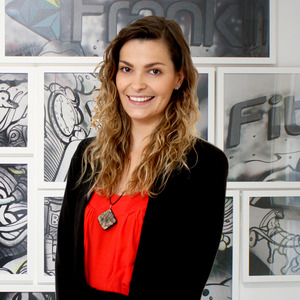
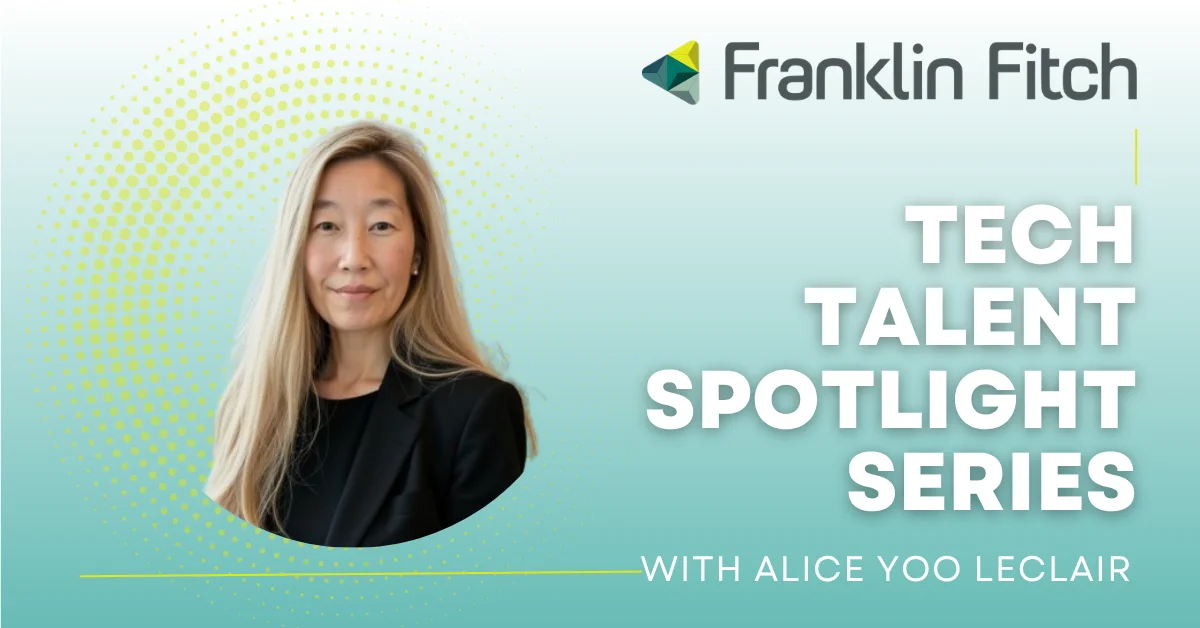
If you’re trying to understand how AI is changing the way we work - not just the tools we use, but the way we think about careers, leadership, and culture - this conversation with Alice Yoo LeClair is worth your time. As Head of Talent, Culture, and Organisational Performance at Ascendion, Alice brings a human-centered perspective to one of the biggest shifts in technology today.
In this post, you’ll learn why she believes the real challenge isn’t just AI bias, but human bias, why executive sponsorship can accelerate a career in ways mentorship alone often cannot, and how leaders can create psychological safety without losing accountability. You’ll also hear what she thinks women in tech need more of - and why communities like Act Three and Chief matter so much.
How Alice Yoo LeClair Built a Hybrid Career in Tech Talent
Alice’s career path is a useful reminder that you do not need a perfectly linear story to build a meaningful career in tech. In fact, she describes her path as a hybrid career - one that began far away from business and technology.
She studied music and English in university, originally pursuing piano performance and also playing violin. Like a lot of people, she hit that moment after school when the “what next?” question becomes impossible to avoid. She didn’t know exactly what she wanted to do, and she says that’s okay. What matters more, in her view, is not expecting someone else to figure it out for you.
That practical mindset led her to apply to law school, where she earned a full scholarship. But even with that opportunity in front of her, she realized law wasn’t the path she actually wanted. Instead, she pivoted and signed up with a staffing agency, which led to a temporary role as a recruitment coordinator at a large optical retail company.
That job changed everything.
She says she had no idea what HR was when she interviewed for the role, but she got hired because the interviewers saw how she solved problems and how she thought through scenarios. Once inside the organization, she became a sponge. She wanted to understand everything - benefits, compensation, talent management, performance management, and how the hiring process connected to the broader business.
That early curiosity shaped the rest of her career. Rather than seeing HR as a narrow function, Alice came to understand it as part of a bigger organizational ecosystem. She now sees talent and culture as inseparable from how companies grow, make decisions, and compete.
Why this matters for your career
Alice’s story is a strong reminder that career clarity often comes from action, not certainty. You may not know your destination at 21, 31, or even later - but you can still move toward better questions.
If you’re early in your career, her advice is simple: pay attention to what draws your curiosity. Learn how your organization works. Ask people what they do. The answers may reveal a path you hadn’t considered.
Why AI Changes the Question “What Do I Want to Do?”
One of the most interesting parts of the conversation is Alice’s perspective on career uncertainty in the age of AI. She makes a point that’s both practical and slightly unsettling: people are no longer just asking, “What do I want to do?” They’re also asking, “What is this work now, and can AI do it?”
That shift changes the way people should think about development, learning, and future careers. Her take is not to panic, but to get more observant. She encourages people to look closely at what they like about their company, notice patterns in what people actually do, and become curious about the work happening around them.
Instead of thinking about roles only through job titles, procedures, and process maps, she suggests looking at the whole organization as an ecosystem. In her words, there are things constantly passing the baton, transferring information, and igniting action across the business. The goal is to figure out where you fit best in that ecosystem.
That matters because AI is increasingly becoming a companion to human work, not just a separate tool. Alice doesn’t frame AI as something that replaces reflection - she frames it as something that makes reflection more important. You need to think not only about the work you do today, but also how that work may be augmented, automated, or redesigned.
She also emphasizes self-service when it comes to learning. The old model, where people wait for a manager or mentor to hand them a path, is fading. The new model requires more proactive learning, more questions, and more personal ownership of development.
A practical way to apply this
If you feel stuck, start with three questions:
- What parts of my company’s work actually interest me?
- What recurring problems do I notice that AI might help solve?
- Who around me can explain what they do and how they got there?
Those answers can help you move from vague uncertainty to informed exploration.
The Real Risk in AI Is Still Human Bias
When the conversation turned to bias in AI, Alice offered a view that pushes past the usual talking points. Yes, AI models can reflect bias. But in her view, the bigger and more immediate issue is still human bias.
That’s because AI is trained on the information people feed it. If humans are biased, incomplete, or inconsistent in the data and decisions they create, those patterns can show up in the output. So while it’s important to monitor algorithms and model behavior, leaders should not ignore the source of the problem: the people and systems shaping the input.
Her point is not to dismiss AI risk. It’s to broaden the lens. If organizations want more equitable outcomes, they need to be honest about the fact that humans have always had bias - and history makes that impossible to ignore. In other words, the work of improving AI fairness starts long before a model is deployed.
Alice also stresses that leaders need to keep advocating on a human level to the people designing these systems. That means raising questions, checking assumptions, and making sure the values behind the technology are clear from the start.
What leaders should take from this
If you’re responsible for AI adoption, don’t make bias a technical-only issue. Treat it as a leadership issue. That means:
- reviewing the quality and origin of your inputs
- challenging assumptions before they become systems
- keeping humans accountable for the decisions behind the data
- asking whether your technology is amplifying existing inequities
Alice’s perspective is a useful correction to the “AI is the problem” narrative. Often, the problem starts earlier - with people, culture, and leadership habits.
Executive Sponsorship, Psychological Safety, and Inclusive Culture
One of the strongest themes in the interview is the difference between mentorship and executive sponsorship. Alice is clear that mentorship matters, especially early in a career. But if you want to move into higher-level leadership, sponsorship is often what makes the real difference.
Why? Because sponsors do more than offer advice. They put their name, credibility, and influence behind you. Alice describes it as someone allocating real capital - political, relationship, and financial - in a person they trust. That kind of support can open doors, stretch your capabilities, and change the trajectory of your career.
She speaks from experience. A leader once saw her potential before she fully saw it herself. He pushed her into stretch roles, even when she resisted. She admits those experiences were uncomfortable, stressful, and full of mistakes, but they changed everything. Without that sponsorship, she believes she would be in a very different place today.
That same leadership lens carries into her thinking about psychological safety. Alice argues that senior leaders set the tone for the whole organization. In her words, they issue “permission slips.” When leaders speak, listen, and respond in a certain way, they signal what behavior is acceptable across the company.
That means psychological safety is not just about making people feel comfortable. It’s about making it safe to speak honestly, ask questions, and raise concerns without sacrificing high performance or accountability. It also means leaders themselves need safe spaces too. Alice notes that many senior executives privately admit they do not always know how to create these conditions, especially when they’re under pressure and moving quickly.
Her metaphor for culture is memorable: values are the seeds, culture is the garden. Everyone contributes to the garden, but senior leadership sets the climate that determines whether people can thrive.
Why this matters for your team
If you want a more inclusive workplace, you need more than policies. You need visible behavior from leaders that gives people permission to show up, speak up, and learn.
Ask yourself:
What does my leadership team reward, intentionally or not?
What behaviors are being modeled from the top?
Do people feel safe enough to ask for support before they burn out?
Those questions are especially important for teams navigating change, growth, or AI adoption. [INTERNAL LINK: What psychological safety looks like in high-performing teams]
Why Women in Tech Need Better Support Networks
Alice also spoke candidly about the realities women face in technology - especially working mothers. She’s transparent that she doesn’t have children herself, which is exactly why she values hearing directly from women who do.
One moment in particular shifted her perspective. She was working late, looked up, and realized it was 8:30 p.m. She texted her husband to make himself dinner because she had completely lost track of time. Then she had a realization: if she had children who needed to be fed, bathed, and put to bed, that kind of work schedule would not be an option.
That moment made her ask an important question: how do working moms in tech do their best work when so much of their day starts before the workday even begins?
Her answer is not to assume. It’s to learn. She says leaders cannot expect telepathy. If they want to understand what working mothers need, they have to create safe, private spaces for those conversations. Better still, they need to proactively ask, listen, and make room for the realities people may not feel comfortable naming.
She also shared how she reached out to a Chief People Officer and asked to be paired with a mentor who was a working mom. What she learned from that relationship was eye-opening. It gave her perspective on the invisible logistics, emotional load, and cognitive switching that many working parents manage daily.
Alice sees that kind of adaptability as a strength, not a weakness. She describes it as a “switching platform” cognitive skill - something that can actually make people highly effective, resilient, and inclusive in leadership.
That’s why communities like Act Three and Chief matter so much to her. Act Three, founded by India Gary Martin, is focused on rewriting the narrative around women in midlife and beyond. Instead of treating midlife as a decline, it celebrates it as a powerful third act. Chief, meanwhile, creates a space for accomplished women to share, support, and confide in each other with honesty.
For Alice, the biggest benefit of these communities is immediate relief: “it’s not just me.” That validation matters. But so does the expanded perspective you gain from hearing how other women have navigated challenges you haven’t faced yourself.
A note for leaders
If you’re building culture, don’t wait for people to struggle in silence. Make space for the realities they’re carrying. That includes parents, caregivers, and anyone balancing work with a complex life outside the office.
The Leader Alice Wants to Learn From Most
When asked who she would choose for a one-to-one mentoring session, Alice named Demis Hassabis, founder of DeepMind. Her interest in him is not just about AI hype - it’s about the way he has applied AI to real-world problems with long-term significance.
She points to DeepMind’s historic work in mastering Go, the ancient board game that became a landmark AI achievement, as well as their breakthroughs in protein folding and research tied to human health and environmental problems. What stands out to her is that Hassabis appears to care deeply about safety alongside innovation.
That combination - ambition plus responsibility - is what she admires most. To Alice, the best AI leaders are not just building impressive systems. They’re thinking about how those systems can help solve critical problems like disease prediction, environmental cleanup, and safer technology use.
What Alice Would Tell Her Younger Self
If she could go back and give her younger self one piece of career advice, Alice says it would be simple: buy Bitcoin.
It’s a playful answer, but her explanation is thoughtful. She’s fascinated by the idea that value is often a collective decision. Money itself is only useful because people agree it is useful. Bitcoin and blockchain challenged her to think differently about what gives something value, who gets to decide, and how technology can reshape those assumptions.
That’s a fitting final note for the conversation. Alice’s career has been shaped by curiosity, by unexpected turns, and by a willingness to rethink what work, value, and leadership can look like.
Frequently Asked Questions
What is executive sponsorship, and how is it different from mentorship?
Mentorship offers guidance, perspective, and support. Executive sponsorship goes further - a sponsor actively advocates for you, uses their influence on your behalf, and takes real professional risk to help you grow.
How can leaders create psychological safety at work?
Leaders create psychological safety by modeling the behavior they want others to follow. That includes listening well, responding without humiliation, inviting honest input, and making it clear that people can speak up without fear.
Why is AI bias such an important topic in talent and culture?
AI bias matters because it can affect hiring, performance, and decision-making at scale. But Alice argues that leaders should also focus on human bias, since AI often reflects the assumptions and data humans provide.
Why do communities for women in tech matter?
They give women a safe space to share realities, compare experiences, and reduce the isolation that can come with leadership. They also help surface practical insights that are hard to get from formal training alone.